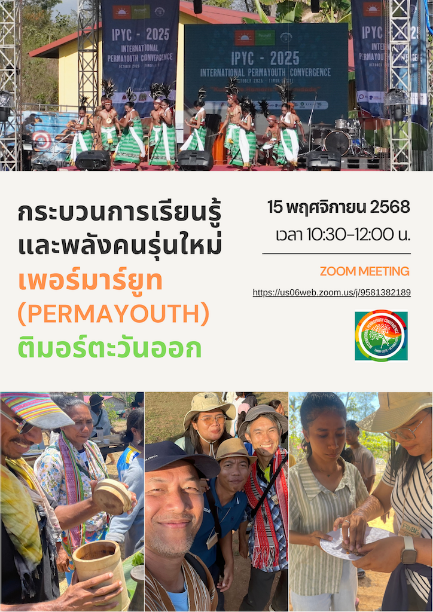
15 November 2025, (Online Learning Platform)
This online session, co-hosted by AAN, shared key lessons from 3 Thai participants at the first International PermaYouth Convergence (IPYC–2025), held October 20-25 in Timor-Leste. The event gathered young global leaders to camp, learn permaculture, and build networks. IPYC–2025’s theme — Planting Water, Growing Communities — emphasizes Timor-Leste’s ongoing work. Permatil, Permatil Global, and PermaYouth aim to expand this movement locally and internationally to communities in need.
Between 10 September and 10 October 2025, TOA prepared for IPYC–2025 in Timor-Leste by consulting with Thai partners and conducting a selection process targeting young farmers and activists engaged in sustainable farming, farmer movements, and permaculture networking. With support from partner organizations, TOA selected Tawat Khamkaew, an organic farmer and Thai Volunteer Service alumnus working on seed sharing and organic markets in Lamphun, and Chanidapa Srisook, a staff member of the Community of Agroecology Foundation in Surin who promotes agroecology, farmer support, and healthy diets. Surin Onprom, a researcher on community forests, rotational farming, seed saving, and climate issues, also joined as an interpreter and resource person, supporting Thai participants and sharing knowledge on local wisdom, carbon credits, and greenwashing.
The online experience-sharing session with partners and the Alternative Agriculture Network (AAN) highlighted how cross-country conferences function as vital learning spaces that strengthen regional permaculture networks, build the next generation of practitioners, and inspire participants to continue community-based work. Key lessons emphasized the foundations of sustainable food systems—water, soil, and seeds—through practical activities such as water and soil management, seed saving, agroforestry mushroom production, forest food processing, and community permaculture initiatives, all of which integrated scientific knowledge with local wisdom. The discussions highlighted Timor-Leste’s strong emphasis on youth education and nationwide promotion of permaculture, as well as the role of networks such as Permatil in advancing food sovereignty, climate adaptation, and cooperative development. Participants also reflected on shared challenges, including weak infrastructure, high seed costs, cultural and language barriers, and limited market access for youth. Overall, the session reinforced the value of hands-on learning, cross-border networking, external support from NGOs, and community leadership in advancing resilient, sovereign, and people-centered food systems.


 Towards Organic Asia